The revolutionary
journey
Rajguru belonged to an organisation with a name, a constitution, a programme and an argument. This section sets out what that organisation was, what it believed, what it did in December 1928, and what happened to it afterwards.
- Organisation
- H.S.R.A.
- Reconstituted
- September 1928, Delhi
- Commander
- Chandra Shekhar Azad
- Rajguru's alias
- Raghunath
- Arrested
- 30 September 1929, Pune
A tradition older than the men who inherited it
The revolutionary strand of the Indian freedom movement did not begin in 1928, and it did not begin with Bhagat Singh. It had a history of more than two decades before Rajguru joined it, and its arguments, methods and failures were all inherited rather than invented.
Bengal, 1905
The partition of Bengal in 1905 produced the Swadeshi movement and, alongside it, the first sustained revolutionary organisations of the modern period — the Anushilan Samiti and, later, Jugantar. Their model was the secret society: cells, oaths, physical training, and actions directed against individual officials. Their inspiration was as much European as Indian — Mazzini's Italy, the Russian populists, and the Irish republican tradition were all read closely.
The Ghadar movement
From 1913 the Ghadar Party, formed among Punjabi migrants on the west coast of North America, planned an armed rising inside India timed to the outbreak of the First World War. The attempt of 1915 was penetrated and crushed, and the trials that followed produced a long list of executions and transportations. Ghadar mattered to the later generation for two reasons: it was explicitly Punjabi, and it had been explicitly secular and egalitarian in composition.
The lesson of the twenties
After the suspension of Non-Cooperation in 1922, a section of younger activists concluded that constitutional agitation and mass civil disobedience had each been tried and each had been stopped short. Out of that conclusion came the Hindustan Republican Association in 1924, and out of the H.R.A.'s wreckage came the organisation Rajguru joined.
A caution about the word “terrorist”
Colonial official records described these organisations as terrorist; nationalist records described them as revolutionary. Both usages are historical evidence about who was writing. This site uses “revolutionary”, which is the term the participants used of themselves, and states plainly what was done in each case so that readers can judge for themselves.
The Hindustan Socialist
Republican Association
In September 1928 delegates from Punjab, the United Provinces, Bihar and elsewhere met in the ruins of Feroz Shah Kotla in Delhi and remade the H.R.A. The single word they added to its name was an argument about what independence was for.
What the reconstitution changed
The H.R.A. had been republican: it wanted the British out and an Indian republic in their place. The H.S.R.A. was republican and socialist. It committed itself, on paper, to the abolition of the exploitation of one person by another — which meant that independence alone would not satisfy it, and that Indian landlords and Indian industrialists were also, in principle, in its sights.
This was not an abstract distinction. It shaped how the group's public statements were written, why Bhagat Singh spent his imprisonment reading political economy, and why the organisation cultivated an open, legal, student-facing front — the Naujawan Bharat Sabha — alongside its clandestine structure.
How it was organised
The association had a central committee responsible for political direction and a separate military wing under a commander-in-chief. Provincial units operated with a degree of independence, which was a security necessity and an organisational weakness in equal measure: it made the whole harder to destroy and much harder to control.
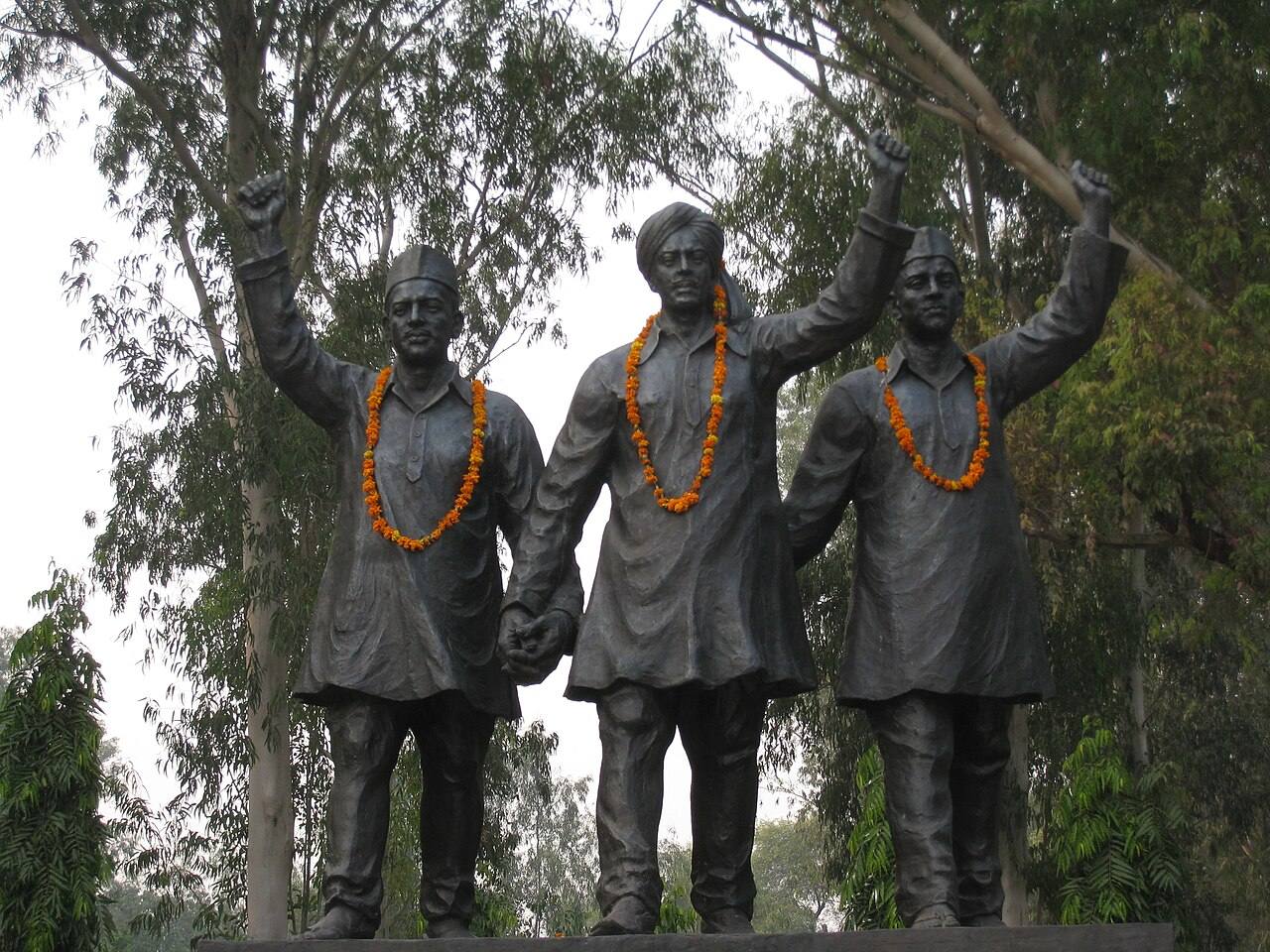
The three H.S.R.A. members condemned to death together, commemorated in bronze.
Central Committee
Political direction, the programme, and authority over major actions. This is where the socialist commitments of 1928 were formulated and where the organisation's public statements originated.
Military wing — commander-in-chief Chandra Shekhar Azad
Operations, weapons, safe houses and movement between provinces. This is the part of the structure to which Rajguru belonged.
Regional units
Semi-autonomous units, of which the Punjab organisation centred on Lahore was the most consequential in this period.
Naujawan Bharat Sabha
A legal, public youth organisation founded at Lahore in 1926 which held meetings, published, and campaigned openly — including against communal politics. It functioned as the recruiting ground and the public face of ideas the clandestine body could not state under its own name.
What they thought they were doing
“Propaganda by deed”
The strategic theory behind the H.S.R.A.'s actions was not that a few hundred people could defeat an empire militarily. Nobody in the organisation believed that. The theory was that a colonial state derives much of its power from the appearance of permanence and consent, and that a dramatic public act — followed by an unapologetic public statement, and then by a trial the government could not control — would puncture that appearance and make the argument for independence audible to people the Congress was not reaching.
The Central Legislative Assembly action of April 1929 is the clearest expression of this. Two low-intensity bombs were thrown into an empty part of the chamber, leaflets were scattered, and the men made no attempt to escape. The bombs were the means; the trial was the object. The leaflet's most quoted line — “it takes a loud voice to make the deaf hear” — is a statement about communication, not about explosives.
The turn towards socialism
Through 1929 and 1930, from prison and through the writings of Bhagwati Charan Vohra and Bhagat Singh, the group's public position moved further towards an explicitly socialist programme and towards mass organisation. The Philosophy of the Bomb, issued in 1930, defended revolutionary action against Gandhian criticism; Bhagat Singh's later writings argued increasingly that the revolutionary's real work was to organise workers and peasants, and that individual action alone could not produce a revolution.
The irony is exact: the H.S.R.A. arrived at the conclusion that armed individual action was insufficient at almost the same moment that armed individual action had made it famous.
It takes a loud voice to make the deaf hear.From the leaflet thrown in the Central Legislative Assembly, 8 April 1929. Rajguru had no part in that action.
The argument against them
Gandhi's objection was moral and strategic at once: that violence corrupts the movement that uses it, and that a mass movement of millions could not be built on acts that only a handful could perform. He restated this position after the executions, while also condemning the government's refusal to commute the sentences.
Many nationalists who admired the courage of the accused agreed with the criticism of the method. This was a live argument at the time, conducted in public between people on the same side of the larger question, and it has never been settled.
Where Rajguru stood inside it
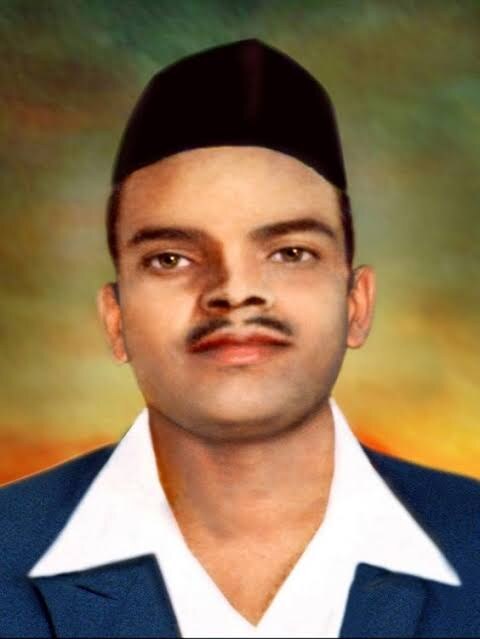
Rajguru was twenty years old at the time of the Lahore action.
Rajguru's position inside the organisation was operational. He was attached to the military wing under Azad; he was regarded as its most reliable marksman; he was trusted with movement between provinces because he could travel plainly, endure discomfort and attract no attention. He was close to Bhagat Singh personally, and the recollections that survive describe an attachment that was uncomplicatedly admiring.
He was not a theorist and did not pretend to be. He appears in no drafting committee, on no publication, in no surviving argument about programme. When the H.S.R.A. issued statements, other people wrote them.
This has produced a persistent distortion in the way he is remembered. Because he did not write, popular accounts have tended either to reduce him to a trigger — a gunman with a famous name — or to compensate by attributing to him sentiments he is not recorded as having expressed. Both are failures of the same kind.
The accurate statement is narrower and more interesting: Rajguru was a disciplined twenty-year-old operative in a small clandestine organisation, whose part in its most consequential action was direct and decisive, and whose own voice does not survive.
Seventeen days, one decision,
and a mistaken identity
The Simon Commission reaches Lahore. Lala Lajpat Rai leads a protest march. Police under Superintendent James A. Scott make a lathi charge; Rai is struck about the head and chest and addresses a meeting that evening regardless.
Lala Lajpat Rai dies. Doctors attribute his death to a heart attack and hold that his injuries hastened it. The government denies any connection. Public opinion in Punjab does not accept the denial.
Outside the District Police Headquarters, Lahore. Jai Gopal signals. Rajguru fires first at the officer leaving on a motorcycle; Bhagat Singh fires further shots. The man is Assistant Superintendent John P. Saunders, not Scott.
Head constable Chanan Singh gives chase and is shot dead by Chandra Shekhar Azad. The party escapes through the grounds of the D.A.V. College.
Printed notices appear across Lahore over the signature “Balraj”, commander-in-chief of the H.S.R.A., acknowledging the killing, connecting it to Rai's death, and expressing regret at having had to kill a man.
What was intended and what happened
The plan was to kill James A. Scott, the superintendent who had ordered the lathi charge. The man who was killed was John P. Saunders, an assistant superintendent of about twenty-one who was still on probation and who had had no part in the events of 30 October. Jai Gopal, posted to identify Scott, gave the signal for the wrong man.
The organisation did not conceal the error, and it did not treat it as exonerating. Its own notice acknowledged that a man had been killed and argued that he had been part of an order that had to be ended — an argument that was, and remains, morally contested.
Chanan Singh, the head constable shot during the escape, was an Indian police officer. He is very often left out of the retelling entirely. He should not be.
How this site presents the incident
Two men were killed. One was the wrong target; the other was a pursuing constable. Three young men were later hanged for it. None of these facts is arranged here to produce excitement or to recommend the act. They are set down because the consequences — the trial, the executions, and the political shock that followed — are a real part of the history of Indian independence.
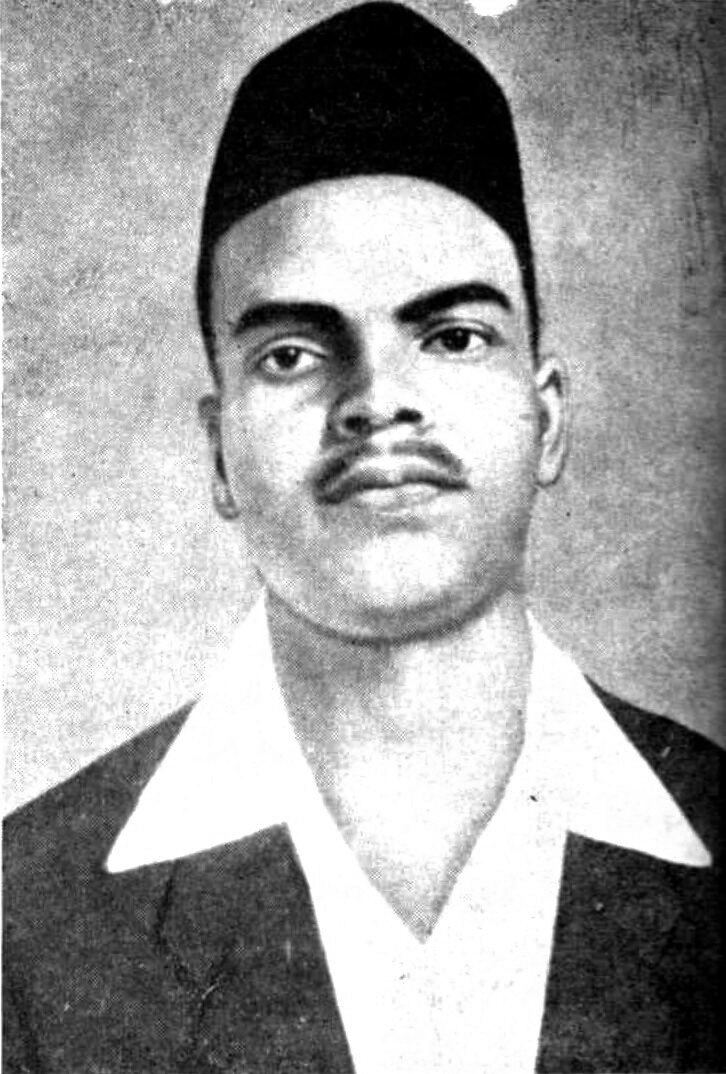
The photograph that would shortly be circulated to police districts across northern and western India.
What revolutionary action cost
A manhunt across northern India
The Punjab police mounted the largest search operation of the period. Photographs and descriptions were circulated; known associates were watched; informers were recruited. The organisation's greatest asset — its dispersal across provinces — became its greatest liability once arrests began, because each arrest opened a new province.
The Assembly action and its trade-off
On 8 April 1929, Bhagat Singh and Batukeshwar Dutt threw bombs in the Central Legislative Assembly and allowed themselves to be arrested. They gained the platform they wanted. They also placed the movement's most articulate figure permanently in custody, where his fingerprints and identity could be matched to the Lahore case.
Raids and the collapse of the apparatus
Within days of the Assembly action, police raided the organisation's bomb factory at Lahore and premises at Saharanpur. Sukhdev, Kishori Lal, Jai Gopal and others were taken. Materials, notebooks and addresses were seized. The Punjab organisation effectively ceased to exist.
Betrayal from inside
Several arrested members turned Crown witness. Jai Gopal, who had given the signal at Lahore, and Hans Raj Vohra supplied the identification evidence that made a murder charge possible; Phonindra Nath Ghosh gave evidence on the organisation's structure. Approver testimony is the reason there was a case at all.
Arrest at Pune
On 30 September 1929, after nine and a half months at liberty, Rajguru was arrested at Pune. A pistol and fourteen cartridges were recovered. He was taken to Lahore to stand trial with the others.
The wing dismantled
Bhagwati Charan Vohra was killed testing a device on the banks of the Ravi in May 1930. Chandra Shekhar Azad died in a gun battle at Alfred Park, Allahabad, on 27 February 1931. Within three years of its reconstitution, the H.S.R.A.'s leadership was dead or imprisoned.