Lahore
& the trial
Crown versus Sukhdev and others. A murder investigation that became a prosecution of an organisation, tried by a court created for the purpose by executive ordinance, and ended by three hangings carried out twelve hours early.
- Case
- Lahore Conspiracy Case
- Opened
- 10 July 1929
- Tribunal
- Ordinance III of 1930
- Judgment
- 7 October 1930
- Executed
- 23 March 1931
Why Lahore
Lahore in 1928 was the administrative and intellectual capital of an undivided Punjab: a university city, a newspaper city, and the headquarters of a provincial police force with long experience of political surveillance. It was also the base of the H.S.R.A.'s most capable regional unit, and the home of the Naujawan Bharat Sabha, the open youth organisation that supplied much of that unit's membership.
The Punjab had its own memory of state violence — Jallianwala Bagh was less than a decade old and ninety kilometres away — and its own tradition of revolutionary organisation running back through the Ghadar movement to the first decade of the century. When the Simon Commission reached Lahore on 30 October 1928 and the police broke up a protest led by Lala Lajpat Rai, the reaction was not a local disturbance. It was a provincial crisis with a national audience.
Rai — “the Lion of Punjab”, a Congress leader of the older generation with an enormous personal following — was struck about the head and chest during the lathi charge ordered under Superintendent James A. Scott. He addressed a public meeting that evening in spite of his injuries and died on 17 November 1928. His doctors held that the assault had hastened his death; the government denied the connection.
It is that denial, as much as the beating itself, that the H.S.R.A. cited in what followed.
The shooting, and the notice
On the afternoon of 17 December 1928, a party from the H.S.R.A. waited near the District Police Headquarters in Lahore with the intention of killing Superintendent Scott. Jai Gopal was posted to identify him. When a young officer came out and started a motorcycle, Jai Gopal gave the signal.
Rajguru fired the first shot. Bhagat Singh fired further shots at close range; the post-mortem recorded multiple bullet wounds. The officer was John P. Saunders, an assistant superintendent of about twenty-one still on probation — not Scott. Head constable Chanan Singh pursued the party and was shot dead by Chandra Shekhar Azad, who was covering the withdrawal. The three escaped through the grounds of the D.A.V. College.
The next day, printed notices appeared across the city over the signature “Balraj” — the nom de guerre used by the commander-in-chief of the H.S.R.A. They did not deny the killing. They explained it.
We are sorry to have had to kill a person but he was part and parcel of that inhuman and unjust order which has to be destroyed.From the H.S.R.A. notice posted across Lahore on 18 December 1928, signed “Balraj”, Commander-in-Chief. The same notice described the public beating of Lala Lajpat Rai by a police official as “an insult to the nation”.
Reading this document carefully
The notice is the closest thing to a contemporaneous statement of motive that exists. It is also a propaganda document, written to be read by a city and by the newspapers, and it should be read as such — as an argument its authors wanted to win, not as a neutral account of what was in their minds.
How the case was built
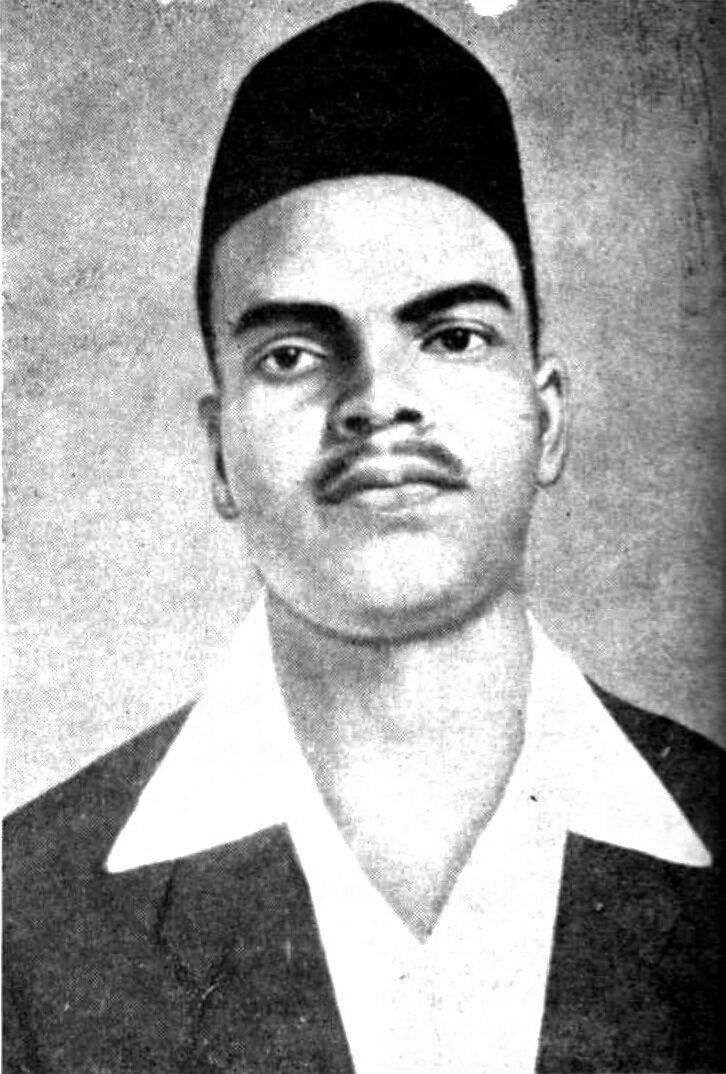
Rajguru remained at liberty for nine and a half months after Lahore, until his arrest at Pune on 30 September 1929.
The break
The Saunders investigation made little progress for four months. What changed it was not detection but the H.S.R.A.'s own decision: on 8 April 1929 Bhagat Singh and Batukeshwar Dutt threw bombs in the Central Legislative Assembly and deliberately allowed themselves to be arrested. Within days, police raided the organisation's bomb factory at Lahore and premises at Saharanpur, seizing materials and papers and taking Sukhdev Thapar, Kishori Lal, Jai Gopal and others.
The approvers
Several of those arrested turned Crown witness under section 337 of the Code of Criminal Procedure, receiving a pardon in exchange for evidence. Those named in the record include Jai Gopal, Hans Raj Vohra, Phonindra Nath Ghosh, Man Mohan Bannerji and Lalit Kumar Mukerji.
Their evidence was decisive. Jai Gopal had been at the scene and had given the signal; Hans Raj Vohra could speak to the organisation's inner working. Without approver testimony the identification evidence in the Saunders killing would have been very much weaker, and it is doubtful that a murder charge could have been sustained against Rajguru and Bhagat Singh at all.
Rajguru's arrest
On 30 September 1929, after nine and a half months moving between safe houses, Rajguru was arrested at Pune. A pistol and fourteen cartridges were recovered. He was transferred to Lahore and joined to the proceedings already under way.
On approver evidence
Evidence from a pardoned accomplice was, and is, treated by courts as requiring corroboration: the witness has an obvious interest in satisfying the prosecution. The defence in this case attacked the approvers' credibility throughout. The tribunal accepted their evidence, and the recovery of a weapon from Rajguru supplied the kind of independent corroboration the law looked for.
A trial of an organisation
Twenty-eight accused. Charges of murder, of conspiracy to murder, and of waging war against the King. Most of those in the dock had fired nothing at all.
What was alleged
The prosecution's case was that the accused were members of a conspiracy — the H.S.R.A. — whose object was to wage war against the King Emperor, and that the murder of J. P. Saunders was an act committed in furtherance of that conspiracy. Framing it this way allowed the Crown to place the whole organisation on trial rather than three individuals, and to use evidence about the association's structure, publications and finances against every accused.
A court inside a jail
Committal proceedings opened on 10 July 1929 inside Borstal Jail, Lahore, before a magistrate. Holding the proceedings within the prison was a security measure. Its effect was to remove the trial from an ordinary public courtroom, and the accused treated that removal as itself a political fact worth protesting.
The dock as a platform
The accused sang, raised slogans of Inquilab Zindabad, declined to participate in parts of the process, and used every opportunity to convert cross-examination into political argument. They were reported at length in the Indian press. The government's difficulty was that suppressing the disruption produced worse publicity than tolerating it.
12 May 1930 — violence in court
The accused were beaten inside the courtroom. Justice Agha Haidar, one of the three judges then sitting, objected and refused to sign the record. He was removed from the bench, and the tribunal was reconstituted the following month. The episode is central to every subsequent criticism of the trial's fairness.
The tribunal that was made for the case
By the spring of 1930 the proceedings had become unmanageable for the government: slow, noisy, and increasingly a national platform for the accused. The response was not a procedural ruling. It was legislation by decree.
On 1 May 1930 the Viceroy, Lord Irwin, promulgated Ordinance III of 1930, creating a Special Tribunal of three High Court judges to try the case. The tribunal could proceed in the absence of the accused and could dispense with parts of the ordinary procedure. There was no appeal from its decision except, on limited grounds, to the Judicial Committee of the Privy Council in London.
The first tribunal sat under Justice J. Coldstream as president, with Justice Agha Haidar and Justice G. C. Hilton. After the events of 12 May and Agha Haidar's removal, it was reconstituted in June 1930 under Justice G. C. Hilton as president, with Justice Abdul Qadir and Justice J. K. Tapp. It was this bench that delivered the judgment.
From that point the accused largely withdrew from participation, and the tribunal exercised its power to proceed without them.
The judgment of 7 October 1930
The tribunal delivered a judgment running to roughly three hundred pages. It sentenced Bhagat Singh, Sukhdev Thapar and Shivaram Rajguru to death by hanging. Others were sentenced to transportation for life or to fixed terms; several accused were acquitted. An execution date of 27 October 1930 was initially fixed and then postponed.
The ordinance under which the tribunal had been created lapsed after roughly six months. The judgment it had produced did not.
The Privy Council
The defence committee appealed to the Judicial Committee of the Privy Council, arguing principally that the ordinance creating the tribunal was invalid — that the Viceroy had exceeded his powers in constituting a court by decree. The appeal was heard in London and dismissed on 11 February 1931, the Board including Viscount Dunedin. The reasons were delivered later that month.
With the dismissal, the case ceased to be a legal question and became a political one: whether the executive would commute the sentences.
| Date | Event | Significance |
|---|---|---|
| 30 Oct 1928 | Lathi charge at Lahore | Lala Lajpat Rai injured during the Simon Commission protest. |
| 17 Nov 1928 | Death of Lala Lajpat Rai | Government denies a connection with his injuries. |
| 17 Dec 1928 | Shooting of J. P. Saunders | Rajguru fires first; Chanan Singh killed during the escape. |
| 8 Apr 1929 | Central Legislative Assembly bombs | Bhagat Singh and Dutt court arrest; Rajguru not involved. |
| Apr 1929 | Raids at Lahore and Saharanpur | Sukhdev and others arrested; approvers emerge. |
| Mid-Jun 1929 | Hunger strike begins | Demand for political-prisoner status. |
| 10 Jul 1929 | Proceedings open at Borstal Jail | Twenty-eight accused named. |
| 13 Sep 1929 | Death of Jatindra Nath Das | Sixty-third day of his fast; national reaction. |
| 30 Sep 1929 | Rajguru arrested at Pune | Pistol and fourteen cartridges recovered. |
| 5 Oct 1929 | Hunger strike ends | After some 116 days; partial concessions. |
| 1 May 1930 | Ordinance III of 1930 | Special Tribunal created by the Viceroy. |
| 12 May 1930 | Accused beaten in court | Justice Agha Haidar protests and is removed. |
| Jun 1930 | Tribunal reconstituted | Hilton, Abdul Qadir and Tapp. |
| 7 Oct 1930 | Judgment | Death sentences for Bhagat Singh, Sukhdev and Rajguru. |
| 11 Feb 1931 | Privy Council appeal dismissed | Last legal avenue closed. |
| 5 Mar 1931 | Gandhi–Irwin Pact | Clemency raised; commutation not granted. |
| 23 Mar 1931 | Execution at Lahore Central Jail | Carried out in the evening, a day early. |
Eighteen months inside
Rajguru spent roughly eighteen months in custody, from his arrest at Pune to his execution: through the committal proceedings, the tail of the hunger strike, the creation of the Special Tribunal, the judgment, the failed appeal and five months under sentence of death.
The hunger strike and what it was about
The strike that began in mid-June 1929 was not about the trial. It was about the classification of prisoners. Indian political prisoners were held under conditions markedly worse than those given to European prisoners: poorer food, no reading matter, no writing materials, and treatment as ordinary criminals. The strikers demanded recognition as political prisoners and equality of treatment.
Jatindra Nath Das died on 13 September 1929, on the sixty-third day of his fast. His body was carried in procession through Lahore and then to Calcutta, where it was met by enormous crowds. It is difficult to overstate the effect: a young man had died in custody over prison rations, and the government had let it happen. Bhagat Singh ended his own fast on 5 October 1929, after some 116 days, following partial concessions.
What is known of Rajguru in prison
Very little, and the honest thing is to say so. He made no long courtroom statement. He published nothing from prison. He conducted no correspondence that survives in general circulation. Where Bhagat Singh's jail notebook, letters and essays give historians a direct line to his thinking through these months, Rajguru's eighteen months are documented almost entirely from the outside — by court records, by prison administration, and by the recollections of others.
The evening of
23 March 1931
The hangings had been fixed for the morning of 24 March. They were carried out on the evening of 23 March 1931, at about seven o'clock, inside Lahore Central Jail — brought forward by roughly twelve hours and moved from dawn to dusk, contrary to standard practice, because the authorities feared public disorder and an attempt at rescue.
Contemporary accounts describe the three men walking to the scaffold together and calling out Inquilab Zindabad. Bhagat Singh was twenty-three; Sukhdev Thapar was twenty-three; Shivaram Rajguru was twenty-two.
The bodies were not handed over to the families. They were removed at night through a breach cut in the rear wall of the jail, taken out towards Ferozepur, and cremated in haste near the village of Ganda Singh Wala on the banks of the Sutlej; the remains were consigned to the river. The manner of the disposal caused lasting anger, and accounts of it vary in their detail. What is not disputed is that the families were denied the bodies and that the cremation was conducted secretly, at night, without them.
The site is commemorated today as the National Martyrs Memorial at Hussainiwala, in Ferozepur district, Punjab.
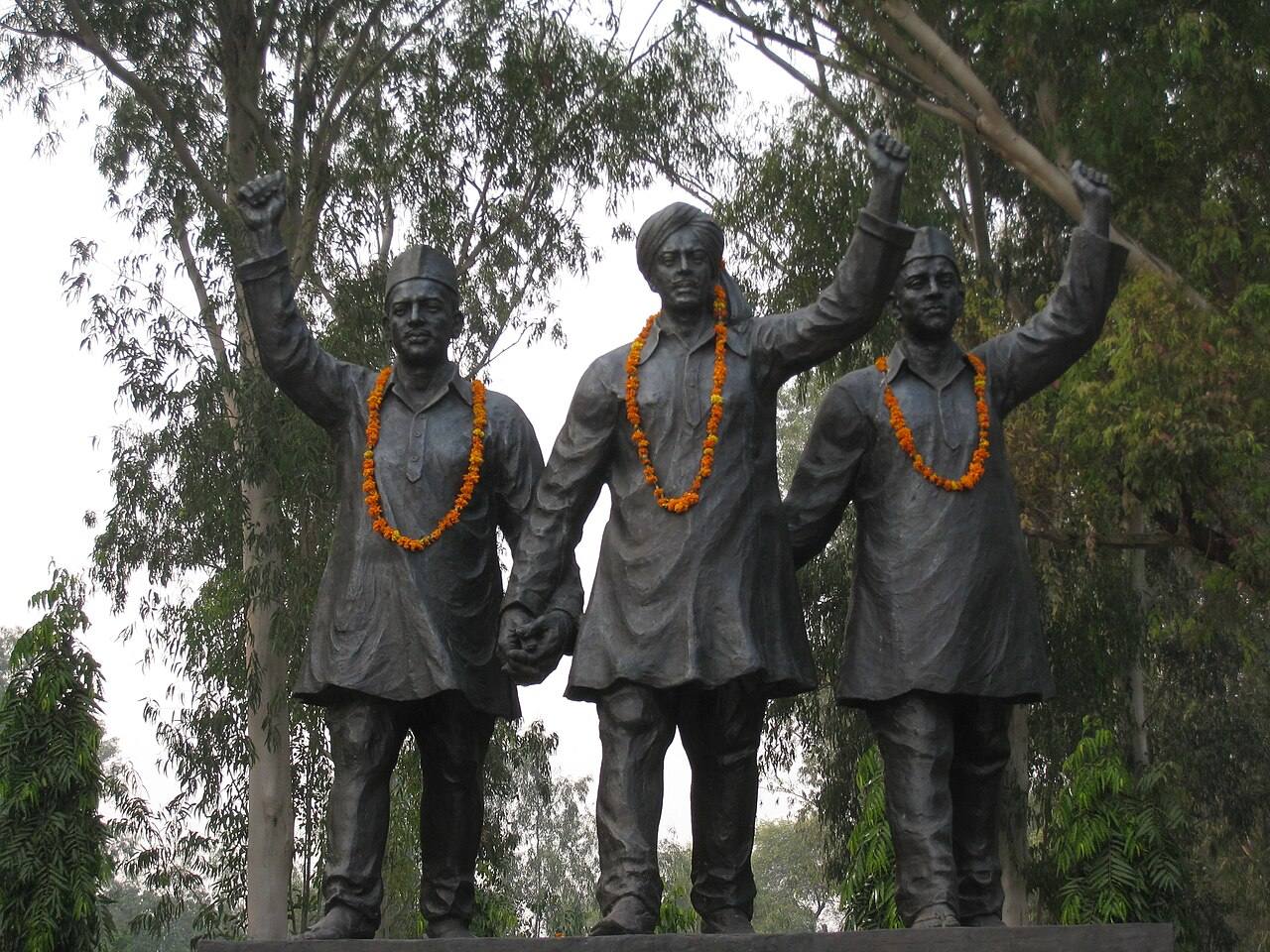
The three men are memorialised together at sites across India, including at Hussainiwala.
- Scheduled
- 24 March, dawn The ordinary hour for an execution.
- Carried out
- 23 March, evening About twelve hours early, at roughly 7 p.m.
- Bodies
- Not returned Removed through a breach in the rear jail wall.
- Cremation
- Ganda Singh Wala On the Sutlej; today the memorial at Hussainiwala.
What historians disagree about
Almost every element of this case is still argued over. Setting out the arguments honestly is more useful than pretending they are settled.
The strongest objection is structural rather than evidential. The court that convicted the accused was created by executive ordinance, for this case, with power to proceed in their absence and with appeal restricted to London. The removal of a judge who protested at the beating of the accused in his courtroom compounds the difficulty.
Defenders of the process argued at the time that the disruption of the ordinary court had made a normal trial impossible and that the tribunal applied ordinary rules of evidence. Against that: it was the government's own prosecution, and a government that writes the court into existence when the existing court is inconvenient has removed the distinction on which a fair trial depends.
This is the most emotionally charged dispute in the whole subject. The facts are that Gandhi raised the death sentences with Lord Irwin during and after the negotiations that produced the Gandhi–Irwin Pact of 5 March 1931, that he pressed for commutation, and that he did not make commutation a condition of the pact.
One view holds that making it a condition might have forced the government's hand, and that the failure to do so was a political choice with a moral cost. Another holds that Irwin was under heavy pressure from the Punjab administration and from British opinion, that no such condition would have been accepted, and that breaking off the settlement would have cost far more than it could have saved. There is no agreed answer, and both positions are held by serious historians.
The official concern was public disorder and the possibility of an organised attempt at rescue. Advancing the hangings by roughly twelve hours and moving them from dawn to dusk denied any crowd a fixed hour to assemble around.
The consequence, however, was to confirm for a very large number of Indians that the government feared the reaction to its own sentence — and the secret night cremation that followed converted an execution into a grievance that outlasted the men.
Contemporaries argued this fiercely and so do historians. The case for harm: it killed a man who had nothing to do with the beating of Lala Lajpat Rai, provided the state with a justification for extraordinary powers, and destroyed an organisation that had begun to develop a serious political programme.
The case for impact: the trial and the executions produced a wave of political mobilisation, particularly among students and young workers; they made the revolutionaries' arguments audible far beyond the few hundred people who held them; and they permanently damaged the moral authority of a government that had asked to be judged by its rule of law.
Both propositions can be true at once, and most careful accounts conclude that they are.
Because historical memory follows documents. Bhagat Singh left essays, letters, a jail notebook and courtroom statements; Sukhdev's correspondence survives; Rajguru left nothing written. He also came from Maharashtra rather than Punjab, and the commemorative infrastructure that grew around the case was overwhelmingly Punjabi.
The result is a strange asymmetry: the man who fired the first shot at Lahore is the one about whom the least can be said with confidence.