The life of
Shivaram Hari Rajguru
Twenty-two years, four of them political. This is the fullest account the surviving record allows — of the household he came from, the schooling he had and lost, the city that changed him, and the organisation that claimed him.
- Born
- 24 August 1908
- Birthplace
- Khed, Pune district
- Parents
- Hari Narayan & Parvati Devi
- Party alias
- Raghunath
- Died
- 23 March 1931, Lahore
A house on the Bhima
Shivaram Hari Rajguru was born on 24 August 1908 at Khed, in the Pune district of what was then the Bombay Presidency. Khed sits on the Bhima river, some fifty kilometres north of Pune on the old road towards Nashik — a trading town, not a village, but far from any centre of power. The family house stood close to the water. It stands there still, and the town itself now carries his name: Rajgurunagar.
The family was Marathi Deshastha Brahmin. The surname is an office rather than a name — rajguru, the preceptor or spiritual teacher to a ruler. Family tradition traces the line to ancestors who held that position under the Maratha court, and the name survived long after the office and its income had gone. What remained was a household with the habits of learning and none of the resources: a distinction that mattered a great deal to a boy's prospects in colonial western India.
His father was Hari Narayan Rajguru; his mother, Parvati Devi. He had an elder brother, Dinkar. The decisive event of his childhood came early: his father died when Shivaram was about six years old, around 1914. In a family without land or salary, the death of the father meant an abrupt narrowing of every option. Responsibility for the household fell to Parvati Devi and to Dinkar, and the younger son grew up as the dependent member of a house that was managing.
It is worth resisting the temptation to over-read this. Bereavement does not manufacture revolutionaries; thousands of Indian boys lost fathers in those years and became clerks, teachers and farmers. But it does explain two things that recur in every account of Rajguru: that he was on his own very early, and that formal education — the thing his family name implied he should have — was the thing he could not finish.
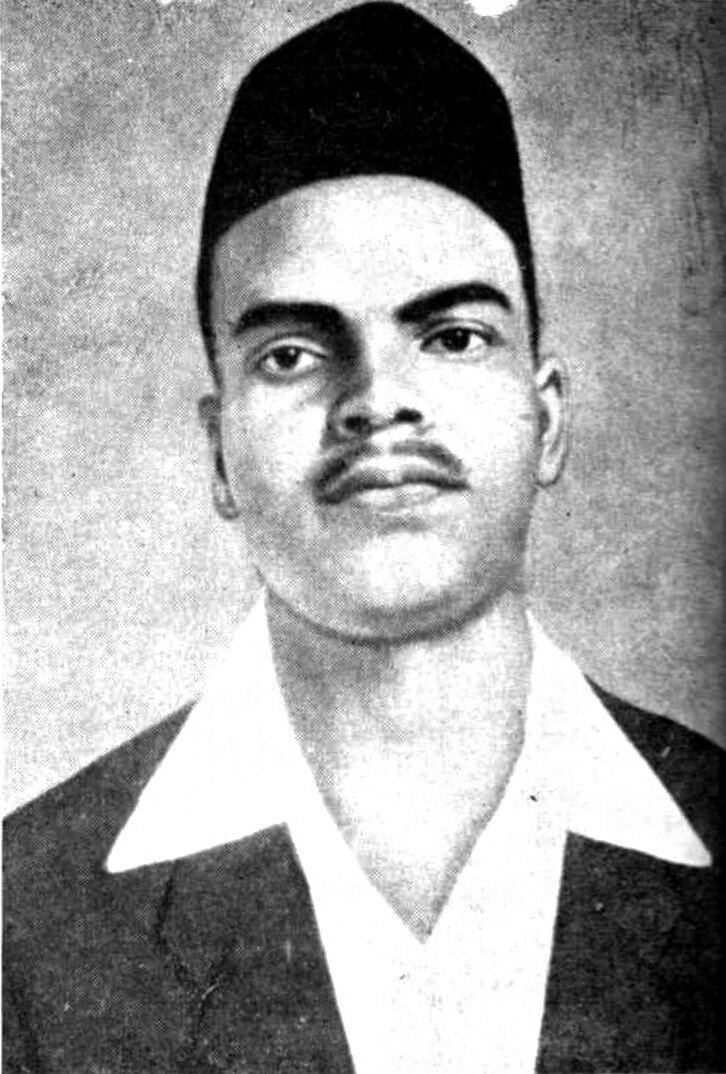
The best-known photograph of Rajguru. Almost every later image of him — painted, sculpted or printed — derives from this one.
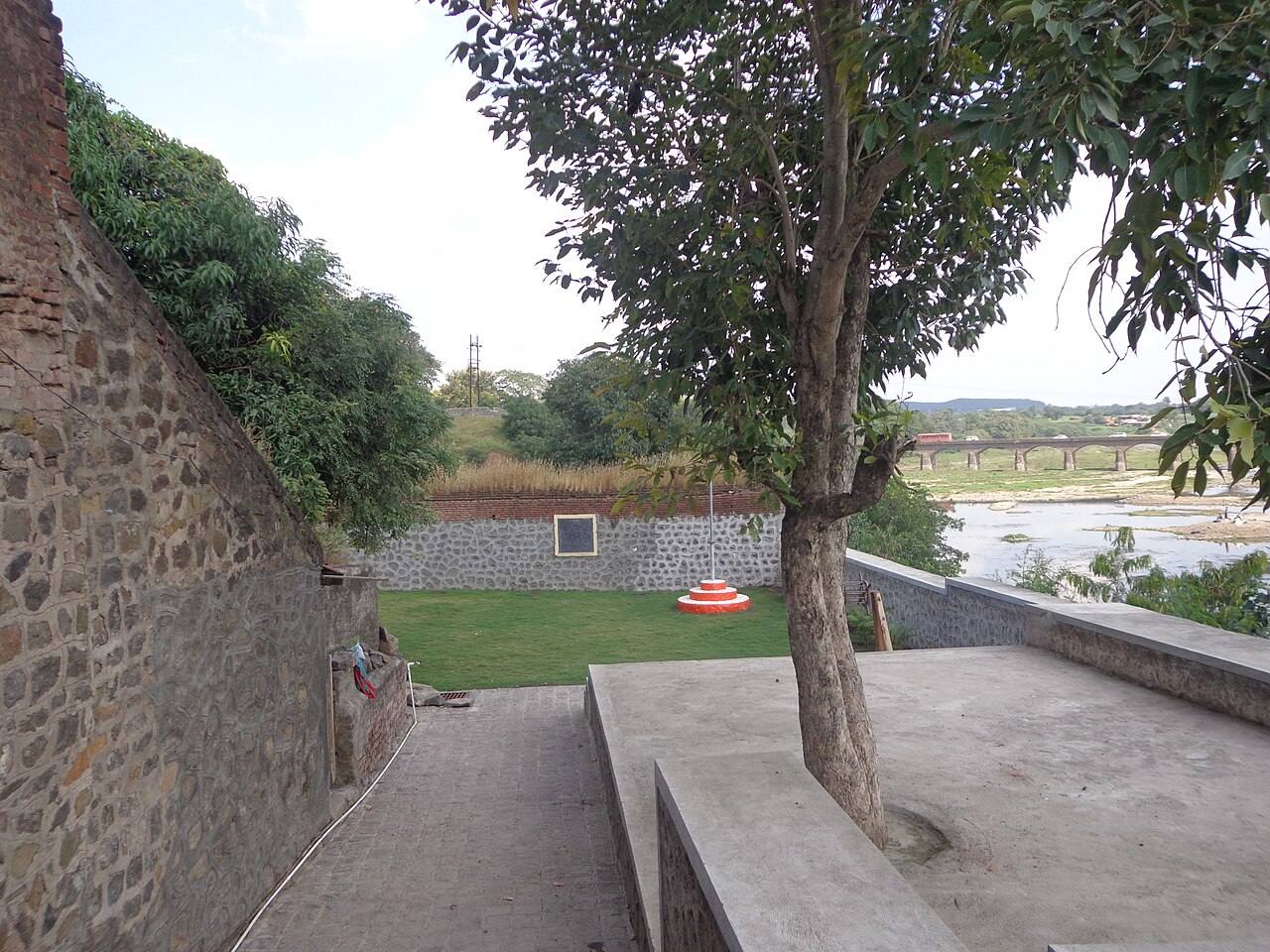
The ground where the family house stood, at Rajgurunagar, looking out over the Bhima.
A plot of 2,788 square metres
The Rajguru Wada — the family's ancestral house — stood on this ground on the bank of the Bhima. The site is maintained as a memorial, and the Hutatma Rajguru Smarak Samiti has hoisted the national flag here each Republic Day since 2004.
It is the only place directly associated with Rajguru's own life that can still be visited. Lahore Central Jail, where he died, is across an international border that did not exist while he was alive.
The atmosphere he came of age in
To understand Rajguru's choices you have to understand where he was standing. Western Maharashtra in the nineteen-twenties was not politically quiet ground.
Pune, forty-odd miles from Khed, had been for half a century one of the intellectual engines of Indian nationalism. Bal Gangadhar Tilak — journalist, Sanskritist, and the man who first made the demand for swaraj sound like a right rather than a request — had built his platform there through the newspapers Kesari and Maratha, through public festivals reorganised as political assemblies, and through a rhetoric that assumed a Maharashtrian audience already fluent in the memory of an independent Maratha state. Tilak died in 1920, when Rajguru was eleven. His argument did not.
Pune also had an older and darker memory. In 1897 the Chapekar brothers had shot dead W. C. Rand, the plague commissioner whose search operations had been experienced by the city as an occupation, and had been hanged for it. That case established a template that would recur for thirty years: an official act experienced as humiliation, an assassination offered as an answer, a trial, and an execution that made martyrs.
Over Rajguru's childhood, the national picture moved fast and then stopped. The Rowlatt Act of 1919 extended emergency powers into peacetime; the massacre at Jallianwala Bagh in April of that year removed any remaining ambiguity about what the state would do when it felt threatened. The Non-Cooperation Movement from 1920 drew unprecedented numbers into political life. Its suspension after Chauri Chaura in February 1922 left many younger participants — including a great many who would never take up arms — with the sense that the country had been mobilised and then sent home.
Somewhere in these years, as a schoolboy in Pune, Rajguru joined the Seva Dal, the Congress volunteer corps. It was, for thousands of young men, the point of contact: drill, discipline, processions, and a first taste of organised political work that did not require a degree or a title. It is the earliest documented political act of his life.
A schooling begun, broken, and rebuilt
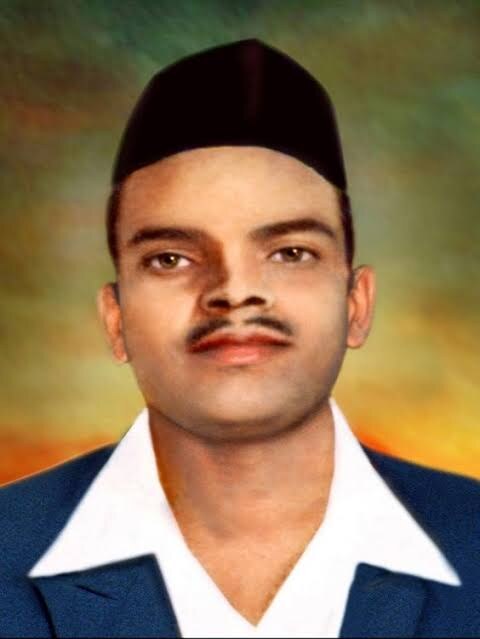
A colourised version of the surviving photograph. The cap — a Maharashtrian topi — is the detail by which he is most often identified.
Khed and Pune
His primary education was at Khed. For secondary schooling he went to Pune, to the New English School — an institution with a nationalist pedigree of its own, founded in 1880 by Tilak and his colleagues precisely to place secondary education in Indian hands. A boy of Rajguru's background at such a school was in the presence of the argument for independence every day, without necessarily having the means to finish the course.
He did not finish it. In his early teens he left Pune — and left home — for Varanasi, a journey of well over a thousand kilometres across the subcontinent, undertaken alone and with no money to speak of. The precise reason is not documented. Accounts variously suggest friction at home, a determination to continue studying on his own terms, and simple restlessness. What is documented is that he went, and that he stayed for years.
Varanasi: Sanskrit, scripture and the akhada
At Varanasi he did what a penniless student could do in that city: he attached himself to traditional learning. He studied Sanskrit and read Hindu scripture — accounts mention the standard grammatical curriculum built on the Laghu Siddhanta Kaumudi — supporting himself with whatever work came, including, by several accounts, teaching younger pupils.
Just as important was what he did outside the classroom. He read in the city's libraries. He attended public speeches and debates — Varanasi in the mid-twenties had a dense student politics of its own, centred on the Banaras Hindu University and on the printing-and-pamphlet trade. And he trained, seriously, at an akhada — a traditional gymnasium — run by the Bharat Seva Mandal, working at wrestling and Indian physical culture.
This combination is the key to him. He was not an intellectual in the manner of Bhagat Singh, who read Marx, Lenin, Bakunin and the Irish republicans and argued about them in print. Rajguru's education was classical, oral, physical and self-directed. It produced a young man of considerable discipline, notable strength, and — the quality every comrade remembered — an unusual steadiness under pressure.
What formal record survives
No school register, examination result or certificate belonging to Rajguru is in general circulation, and no autobiographical account by him exists. The outline above rests on the recollections of contemporaries and on the standard biographical literature. It should be read as a well-attested outline, not as a documented curriculum.
From student to “Raghunath”
Varanasi was where the two halves of his life met. The city's student quarters were a recruiting ground for the revolutionary underground of northern India, and the network he encountered there was the Hindustan Republican Association — founded in 1924 by Sachindra Nath Sanyal, Ram Prasad Bismil, Jogesh Chandra Chatterjee and others as an attempt to give armed resistance an organisation, a constitution and a written programme rather than leaving it to isolated acts.
The H.R.A. was badly damaged by the aftermath of the Kakori train action of August 1925. The prosecutions that followed ended in 1927 with the executions of Ram Prasad Bismil, Ashfaqulla Khan, Roshan Singh and Rajendra Lahiri. What remained regrouped, and in September 1928, at a meeting in the ruins of Feroz Shah Kotla in Delhi, was reconstituted as the Hindustan Socialist Republican Association under a central committee, with Chandra Shekhar Azad commanding its military wing.
Rajguru joined this world and was given a party name: Raghunath. Members of clandestine organisations used aliases as a matter of security, and the name is how he appears in a good deal of the internal recollection.
What his comrades remembered
The consistent portrait is of a young man who spoke very little, took physical risk without visible anxiety, and was regarded within the group as its best shot. He is described as impatient with theoretical argument, devoted to Bhagat Singh personally, and — in one recurring anecdote — competitive to the point of obstinacy about who would be given a dangerous assignment.
He is also described as capable of extraordinary physical endurance: long distances on foot, long periods without food, sleeping rough while moving between safe houses. These were not romantic qualities. They were the practical requirements of remaining at liberty in a country where the police had photographs, informers and railways.
The one thing he did not do
He did not write. Bhagat Singh produced essays, a jail notebook, letters and courtroom statements. Bhagwati Charan Vohra drafted the organisation's philosophy. Sukhdev's correspondence survives. Rajguru left no known text of his own — no letters, no statement, no memoir. Every sentence attributed to him in popular retellings should be treated with suspicion unless a source is given.
This silence is the central problem of his biography, and this archive would rather state it than paper over it with invented dialogue.
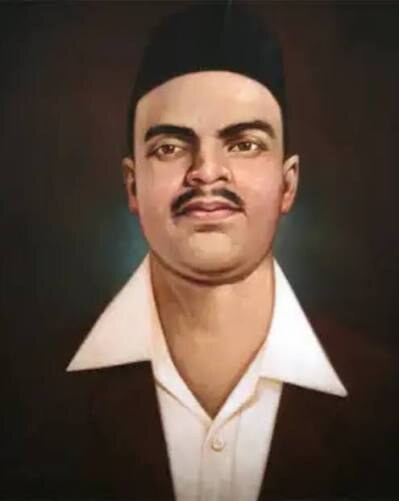
A posthumous painted portrait. No image of Rajguru made during his years in the H.S.R.A. is known; every depiction of “Raghunath” is a reconstruction.
He is the member of the trio about whom the least was written, by others and by himself — and the one whose part in the events of December 1928 was the most direct.On the difficulty of writing Rajguru's biography
A life that was not only one afternoon
Rajguru is usually introduced with a single sentence about 17 December 1928. Here is what that sentence leaves out.
Nine and a half months underground
Between the shooting at Lahore on 17 December 1928 and his arrest at Pune on 30 September 1929, Rajguru was a wanted man moving across northern and central India with his description circulated to every police district on the route. He left Lahore in the company of Bhagat Singh and Durgawati Devi — Bhagat Singh disguised, Durgawati Devi posing as his wife with her infant son, and Rajguru travelling as their servant — and then separated from them and moved alone. That he was not taken for nine and a half months tells you something about both the man and the network that sheltered him.
He was not at the Assembly
The bombs thrown in the Central Legislative Assembly on 8 April 1929 were the work of Bhagat Singh and Batukeshwar Dutt, who deliberately allowed themselves to be arrested in order to gain a courtroom platform. Rajguru had no part in it. Popular accounts frequently merge the two episodes; they are separate acts, months apart, with different participants and entirely different purposes.
Eighteen months in custody
From arrest in September 1929 to execution in March 1931 he spent about eighteen months in prison — through the committal proceedings, the prisoners' hunger strike and its aftermath, the creation of the Special Tribunal by ordinance in May 1930, the judgment of 7 October 1930, the failed Privy Council appeal and the final months under sentence of death. That is a long time to be twenty-one years old and waiting.
He was convicted of conspiracy as well as murder
The Lahore Conspiracy Case was not simply a murder trial. It charged an organisation: conspiracy to wage war against the King, with the Saunders killing as its most serious particular. Understanding that is what separates a criminal anecdote from a political history — and it is why twenty-eight people, most of whom fired nothing at all, stood in the dock.
He was a person, not an emblem
A boy from a Brahmin household with no money, whose father died when he was six, who could not finish school, who walked out of Maharashtra at fourteen or fifteen and learned Sanskrit and wrestling in Varanasi because those were the forms of education available to him. Everything else follows from that, and none of it is legible if he is only ever the third name in a list.
What remains unknown
The exact circumstances of his departure from home. His movements through 1926 and 1927 in any detail. What he read at Varanasi beyond the classical curriculum. What he said in custody. Whether any of the remarks attributed to him in later popular accounts were actually made. These gaps are real and this archive does not fill them.